

Playbook · Tourism
Destination Marketing: How Tourism Managers Can Create Always-On Digital Experiences
Small team, tight budget, high expectations. Here's how to build digital experiences that engage travelers around the clock and prove results.
 AuthorSteve Dunkley· Head of Growth16 min read
- Use Case
- Destination Marketing
- Audience
- DMOs · Tourism Managers
- Format
- Step-by-Step Playbook
- Group Size
- Open to All Visitors
- Duration
- Always-On
- Effort to Run
- Low to Medium
If you manage tourism for a city, county, or region, you already know the drill: small team, tight budget, high expectations. Destination marketing in 2026 demands more than seasonal campaigns and glossy brochures. It requires digital experiences that work around the clock, engage travelers at every stage of their journey, and deliver measurable results to the stakeholders who fund your work.
This guide breaks down practical marketing strategies that overworked tourism managers can actually execute-from gamified city quests to local business partnerships-and shows how always-on digital tools can become the backbone of your destination's brand.
What Is Destination Marketing in 2025–2026?
Destination marketing is the practice of promoting a specific place-a city like Savannah, Georgia, a town like Bend, Oregon, or a region like Napa County, California-to attract visitors and support local economies. It covers everything from branding and content creation to digital campaigns and partnership coordination.
The institutional backbone of this work falls to destination marketing organizations (DMOs), convention and visitors bureaus, and tourist boards. In North America, you'll find city-level DMOs like Visit Denver, county-level organizations like Explore Asheville in Buncombe County, and state-level boards like Visit California. In Europe, national tourism boards such as VisitBritain and regional alliances like Bavaria's marketing agency serve similar functions. DMOs help attract visitors to specific destinations and are crucial for developing destination brand identity.
The field has changed dramatically. Tourism marketing requires moving from traditional promotion to data-driven stewardship in 2026. Destination marketing focuses on building strong brands and creating meaningful visitor experiences across every touchpoint-before, during, and after someone's trip. Destinations should optimize marketing for AI-powered discovery and conversational search, and DMOs must optimize for AI visibility for itinerary building via structured data.
Destination marketing now increasingly overlaps with experience design, visitor management, and community building. It's not just about getting people to show up-it's about shaping what happens when they do, and how those experiences ripple through the local economy. Platforms like ReadySet help DMOs and tourism marketers turn destinations into interactive, always-on playgrounds that engage both visitors and residents.
The Role of Destination Marketing Organizations (DMOs) Today
Most DMOs operate with small teams juggling enormous responsibilities. On any given week, staff might be updating the website, coordinating with a hotel partner, fielding media inquiries, managing social media, and preparing a board report-all before lunch.
Typical DMO responsibilities include:
- Defining and maintaining the region's brand
- Running marketing campaigns across digital and traditional channels
- Managing visitor guides, maps, and the destination website
- Coordinating with hotels, attractions, restaurants, and travel agencies
- Reporting economic impact and visitation data to government departments and stakeholders
Scale varies widely. A city DMO like Visit Denver handles everything from major conferences to food-scene promotion. A county DMO like Explore Asheville extends its reach into surrounding rural communities and trail networks. Regional tourism alliances in Europe pool resources across multiple small communities.
DMOs must balance the interests of local businesses, residents, and visitors. Effective DMOs leverage partnerships with airlines and local businesses to stretch budgets and spread economic benefit. They must also create authentic content highlighting local traditions to stand out in a crowded global tourism landscape.
The expectations keep rising. DMOs use data to track tourist behavior and preferences, blend first-party data and predictive analytics to target micro-audiences effectively, and leverage real-time travel-intent signals from billions of data points. They track visitor journeys from online search to in-destination spending. Effective DMOs use data for precise audience targeting. DMOs use mobile phone data to track tourist movements. And stakeholders and local governments require campaigns to tie awareness to verified visitor spend.
Later sections will show how always-on, self-guided digital experiences can help DMOs extend their impact without adding full-time staff.
Core Destination Marketing Strategies for Overworked Teams
When time and budget are limited, focus on strategies that deliver the highest return with the least ongoing effort.
1. Clear brand positioning. Small cities can attract tourists by developing a unique destination identity. Are you a heritage town, an outdoor adventure hub, or a culinary destination? Define it clearly and let it guide everything.
2. Focused target markets. Small cities should target specific tourist markets to maximize their marketing efforts. Mackinac Island Tourism, for example, expanded campaigns into warmer markets like Florida and Texas, reframing the island as a "cool summer escape" and attracting higher-value overnight visitors.
3. Consistent digital foundations. Digital marketing allows small cities to reach wider audiences without huge budgets. Experience Grand Rapids reorganized its CMS, SEO, and digital asset management, achieving top-3 rankings for over 50% of its top search terms. Content marketing builds trust and credibility with potential visitors.
4. Strong partner ecosystem. Partnerships between local businesses enhance tourism marketing efforts in small cities. Regional tourism circuits can help small cities benefit from nearby popular destinations through joint promotions and co-op campaigns.
5. Signature events. Organizing signature events can elevate a small city's visibility as a tourist destination. Events can create powerful reasons for visitors to come to a destination-think "Winter Lights in Old Town" or a county-wide harvest festival.
6. Measurable goals. Set KPIs before launching anything. Experience-driven tourism has become the primary catalyst for booking in 2026, and niche tourism requires identifying segments where destinations have competitive advantages.
Small cities should promote experiences rather than just attractions to attract tourists. Instead of ten scattered projects, prioritize one flagship annual campaign plus one always-on digital experience-like an "Ale Trail of Lancaster County"-that runs year-round, creating reusable content and visitor data.
Building an Always-On Digital Experience for Your City or Region
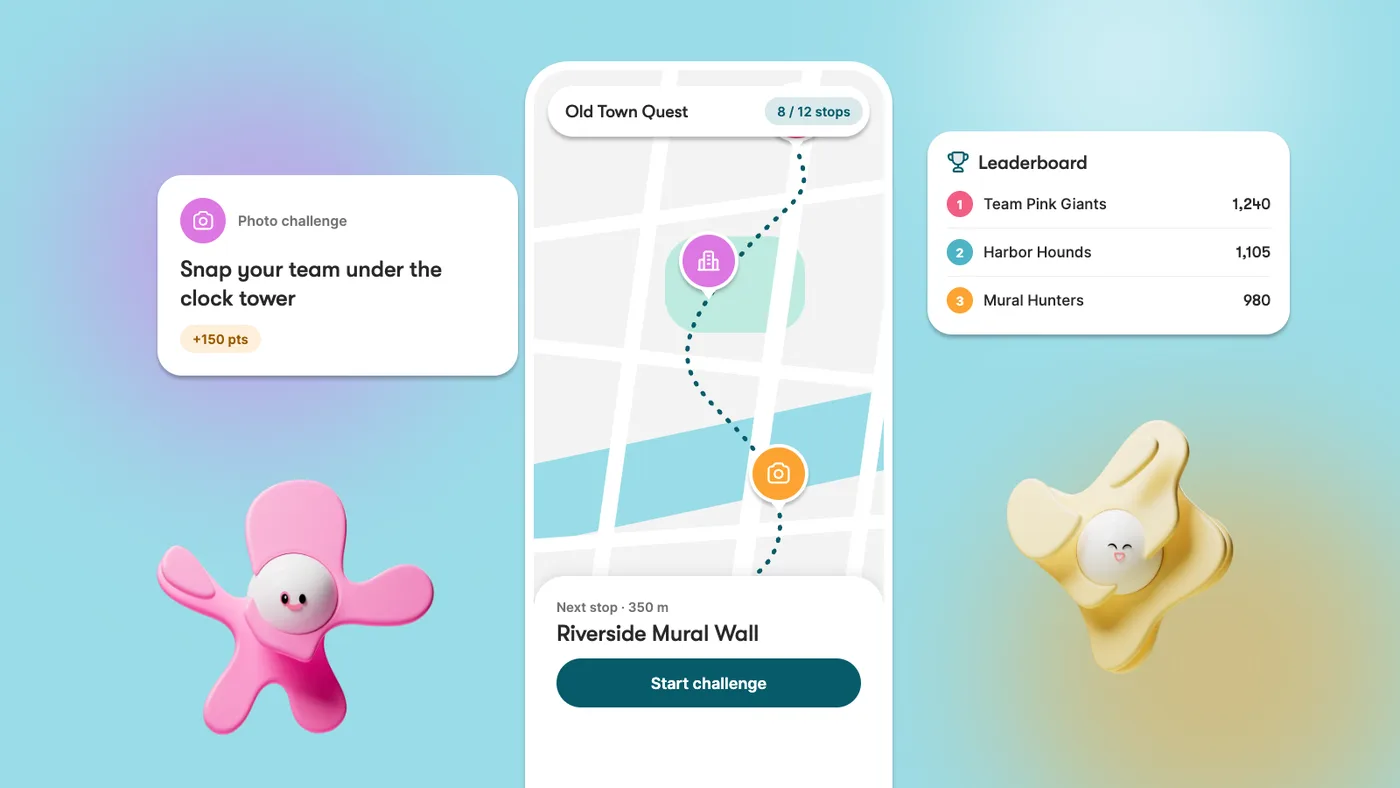
Tourism managers need something that works around the clock-not just during peak season or when the visitor center is open. An always-on experience is a self-guided, mobile-friendly layer over your city, available every day regardless of weather, staffing levels, or event schedules.
Picture this: a traveler arrives in your town on a Saturday evening in July 2026. There's no visitor center open. But a QR code at the hotel concierge launches an interactive city quest on their phone. They discover nearby restaurants, a curated mural trail, and a morning walking route-all without needing a staff member present.
Modern travelers want emotionally resonant stories about local experiences, and 80% of consumers prefer authentic storytelling in marketing. An always-on experience delivers exactly that. It can serve multiple segments: first-time tourists get strong orientation and discovery tools, repeat visitors find new trails and hidden gems, local families explore neighborhoods they've never visited, and remote workers on "workcations" get low-friction, flexible experiences.
Seasonality smoothing-marketing shoulder and off-peak seasons to combat over-tourism-becomes far easier with an always-on platform. Menorca extended its tourism season from four to nine months using data-driven planning. Your city can achieve similar results by rotating seasonal content through a single digital experience.
Tools like ReadySet let DMOs configure these experiences once, then update content-new clues, routes, seasonal themes-without developers. It's an interactive event platform that turns physical spaces into engaging experiences with minimal ongoing maintenance.
Gamifying Discovery: Scavenger Hunts and Location-Based Challenges
Gamification means turning city exploration into a game: missions, points, photos, trivia, unlocks. It makes discovery immersive, memorable, and shareable-and it can increase dwell time and spread foot traffic across your entire destination.
Concrete formats include:
- Downtown scavenger hunts with photo and trivia challenges at landmarks
- Mural and street art trails that guide visitors through neighborhoods
- Historic quests that unlock stories from local archives at each stop
- Brewery or coffee shop crawls with tasting challenges and rewards
- Museum quest trails that gamify exhibitions
- Farm-to-table challenges connecting farms, orchards, and restaurants
ReadySet enables tourism managers to build these as mobile multiplayer city scavenger hunts: teams scan QR codes, complete photo and trivia challenges, and unlock stories about local history or different cultures. DMOs must create emotionally resonant stories to attract travelers, and authentic content from local voices enhances destination marketing effectiveness.
Use case 1: "Heritage Quest" - A small historic town maps five landmark buildings. Each stop includes archived photos and oral history clips. Local businesses along the route offer discounts upon completion.
Use case 2: "Riverfront Adventure" - A mid-size city creates challenges at public art installations, waterfront attractions, and food vendors along its riverbanks.
Use case 3: "Countywide Harvest Trail" - A rural region connects farms, orchards, and vineyards as stops, with seasonal challenges like recipe photo contests.
Successful campaigns focus on human-scale storytelling and authentic local voices. Travel Oregon uses multichannel storytelling to engage potential tourists. Saudi Arabia's AlUla destination weaves ancient and modern stories to draw visitors. Oslo's storytelling campaign went viral by highlighting local perspectives. Video-first strategies enhance visual storytelling to inspire travel in destinations-short clips from each quest stop make natural social content.
Games can be branded fully to the city or county-logos, colors, mascots-so the experience feels like an official part of the destination image, not a generic app. Gamification appeals across ages: families with kids enjoy photo challenges, student groups thrive on team competition, and corporate retreats use team-based scavenger hunts for group bonding.
Partnering with Local Businesses and Attractions
One of the most powerful things destination marketing can do is literally guide foot traffic to local businesses through digital experiences.
Structure partnerships so that merchants, cafes, museums, independent shops, and attractions opt in as "stops" on the game map. Each business can provide:
- A free bakery sample after completing a nearby challenge
- A small discount at a bookstore for showing a completed mission
- A special tasting flight at a brewery tied to game progression
- A behind-the-scenes peek at a workshop or studio
Mutual benefits are clear: visitors discover hidden gems off the beaten path, businesses earn incremental revenue and new customers, and DMOs demonstrate tangible economic impact across the town or county.
Sustainable tourism is increasingly expected to generate positive economic outcomes. Research shows 80% of consumers prefer sustainable travel options and are willing to pay 10% more for sustainable travel. Meanwhile, 78% of travelers prioritize eco-friendly destinations, and sustainable travel features influence traveler choices significantly. By spreading foot traffic to local communities beyond marquee attractions, these partnerships support sustainability goals naturally.
ReadySet lets cities embed custom offers, branded content, and sponsor messages at specific locations without needing custom development. Cities can use the platform to power community events that keep residents and visitors engaged year-round.
Vignette: "Downtown Ridgefield Rewards Trail." Twenty local businesses-cafes, shops, a pottery studio, a bookstore, a small museum-are mapped as stops on a year-round city quest. Each challenge invites the visitor to take a photo or answer trivia. Some businesses offer a small reward upon completion. The journey takes about two hours. A local restaurant hosts a "finish party" where players redeem offers. Residents and tourists alike participate. The DMO tracks completions, offer redemptions, and foot traffic patterns. Sponsors help underwrite rewards. Result: measurable money flowing into local economies.
Using Digital Marketing to Engage Travelers Before, During, and After Their Visit
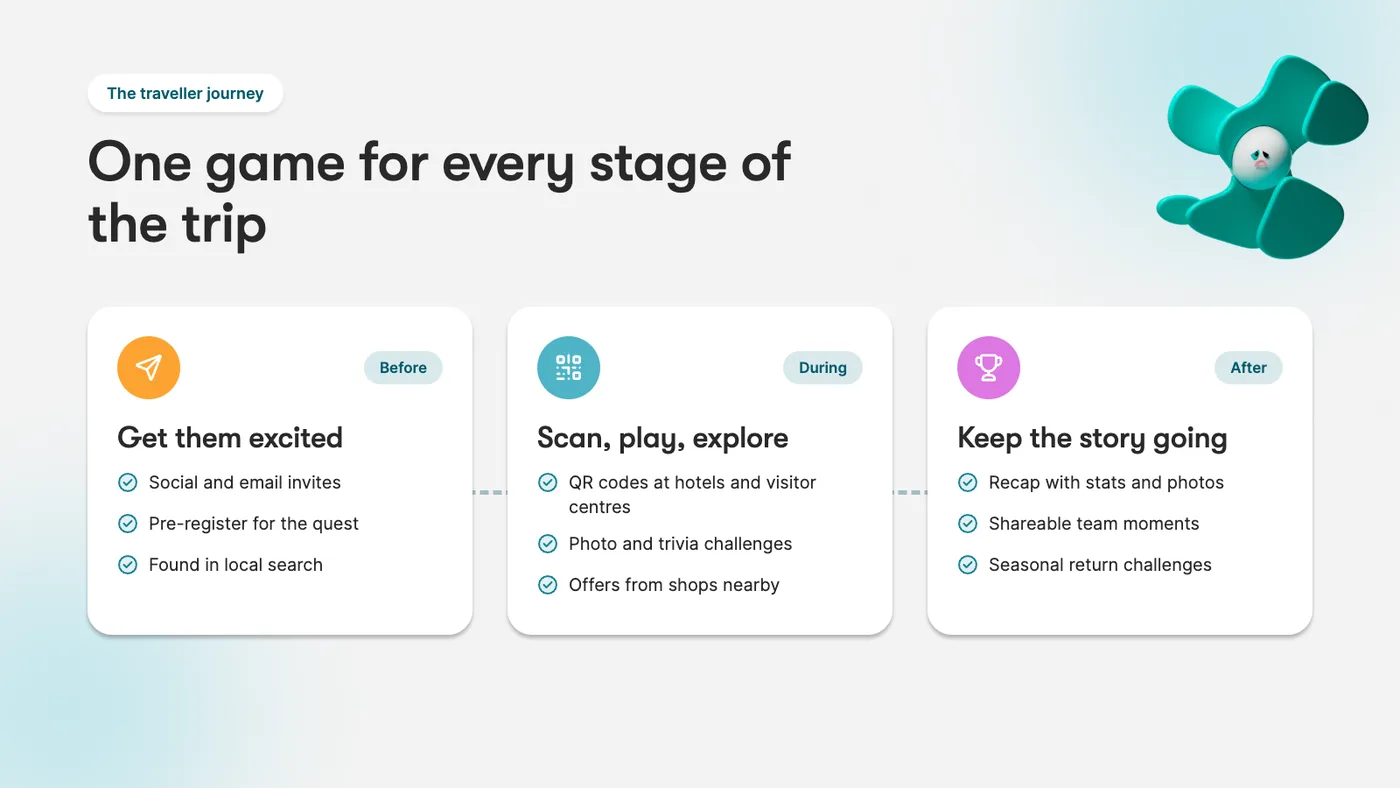
Digital marketing touchpoints must cover the full traveler journey: awareness, planning, on-site experience, and post-trip engagement.
Before the visit:
- Run targeted social media campaigns and online ads to reach potential visitors in drive markets
- Multilingual SEO helps attract international tourists effectively (especially important since 58% of global tourists travel by air and may search in their native language)
- Invite people to pre-register for a city challenge or download the self-guided game
- Travel influencers can enhance tourism through authentic experiences and storytelling-consider partnering with creators who align with your brand
Modern travelers prioritize authenticity, sustainability, and emotional resonance in travel experiences. Your "before" messaging should reflect that.
During the visit:
- Place QR codes in hotels, visitor centers, and transit hubs that launch the ReadySet-powered experience
- Send SMS or email marketing reminders with dynamic content: weather prompts, event reminders, special offers
- Share in-market social media content featuring real visitors playing the game
After the visit:
- Send recap emails with game stats, leaderboards, and photos from the experience
- Invite visitors to share their stories (user-generated content)
- Offer return-visit challenges or seasonal versions of the game to drive repeat visitation
ReadySet acts as the anchor experience that all these marketing campaigns point to, simplifying decision making for small teams. Every advertisement can say: "Play the [City Name] Quest while you're here." Every email can link to the interactive game. Visit Anaheim's creator-led content campaign demonstrated this approach, delivering approximately $791,800 in potential economic impact in just 90 days.
Social Media and Content Ideas That Amplify Your Destination Game
Content and social media are especially valuable when there is a concrete, interactive experience to promote. Instead of scrambling for creative ideas week after week, your game gives you a built-in content engine.
Formats that work:
- Short TikTok/Instagram Reels of teams solving clues at local landmarks
- YouTube Shorts showcasing top murals or stops from the trail
- Blog posts like "Top 10 Spots Featured in Our City Quest"
- Feature stories profiling partner businesses on the trail
Encourage user-generated content with custom hashtags (e.g., #DiscoverRidgefield), in-game prompts to share photos at each stop, and contests for the best team name or most creative picture. Travel Oregon uses multichannel storytelling to engage potential tourists-you can do the same by connecting your social channels to the game experience.
Collaborate with local influencers or resident ambassadors to play through the game on launch weekend. Have them document the experience across platforms. Visit Salt Lake's creator campaign generated over 10 million impressions and a nearly 5% engagement rate using this exact approach.
Social posts can subtly capture first party data by driving people to sign up for game access via email or SMS. Sample captions:
- Instagram: "Can you find all 12 hidden murals in [City Name]? Start the quest 👉 link in bio"
- Facebook: "Families, foodies, and history buffs-our new city game has a trail for everyone. Sign up free."
- LinkedIn: "Calling local business owners: join our city quest and drive new customers to your door."
Collecting and Using First-Party Data from Destination Experiences
First party data is information you collect directly from visitors-with their consent-when they register for your experiences or subscribe to updates. It's distinct from third-party cookies or purchased lists, and it's becoming the most valuable asset in any destination marketer's toolkit.
An interactive, ReadySet-powered game naturally generates first party data:
- Sign-ups: emails, opt-ins, demographic interests
- Gameplay behavior: which neighborhoods players explored, which stops they visited or skipped, time spent at each location
- Feedback: post-game surveys, ratings, comments
Why this matters for destination marketers: you build an owned audience for future campaigns, understand which attractions and areas are most popular, and demonstrate value to stakeholders with hard numbers.
Practical insights you can uncover:
- Visitors consistently skip a particular stop → improve signage or swap in a more compelling location
- Local residents use the game most during shoulder seasons → create targeted off-peak content
- One partner business's offer gets redeemed three times more than others → learn what travelers actually value
DMOs use mobile phone data to track tourist movements broadly, but game-based first party data gives you richer, permission-based insight at the individual level. Privacy and transparency are essential-be clear about how data is used, comply with regulations like GDPR, and ensure opt-ins are genuine.
This data improves future marketing strategies: refining social media targeting, choosing new themes for quests, or pitching sponsorships based on proven engagement metrics.
Measuring Success: KPIs for Destination Marketing Campaigns and Games
Destination marketing in 2026 requires moving past vanity metrics and adapting to AI-driven search. City councils, funders, and tourism boards want outcomes-not impressions.
Campaign-level KPIs:
| Metric | What It Tells You |
|---|---|
| Website sessions from target markets | Reach and interest |
| Email list growth | Owned audience size |
| Social engagement rate | Content resonance |
| Campaign-attributed bookings | Conversion |
| Advertising ROI | Cost efficiency |
Game/experience-specific KPIs:
| Metric | What It Tells You |
|---|---|
| Number of players | Adoption |
| Completion rate | Engagement quality |
| Average time spent exploring | Dwell time |
| Neighborhoods visited | Geographic spread |
| Offers redeemed | Business impact |
| Repeat plays | Loyalty |
Marketing effectiveness should be evaluated through measurable objectives and KPIs set before launch. Data-driven marketing helps DMOs measure ROI and secure funding from local government.
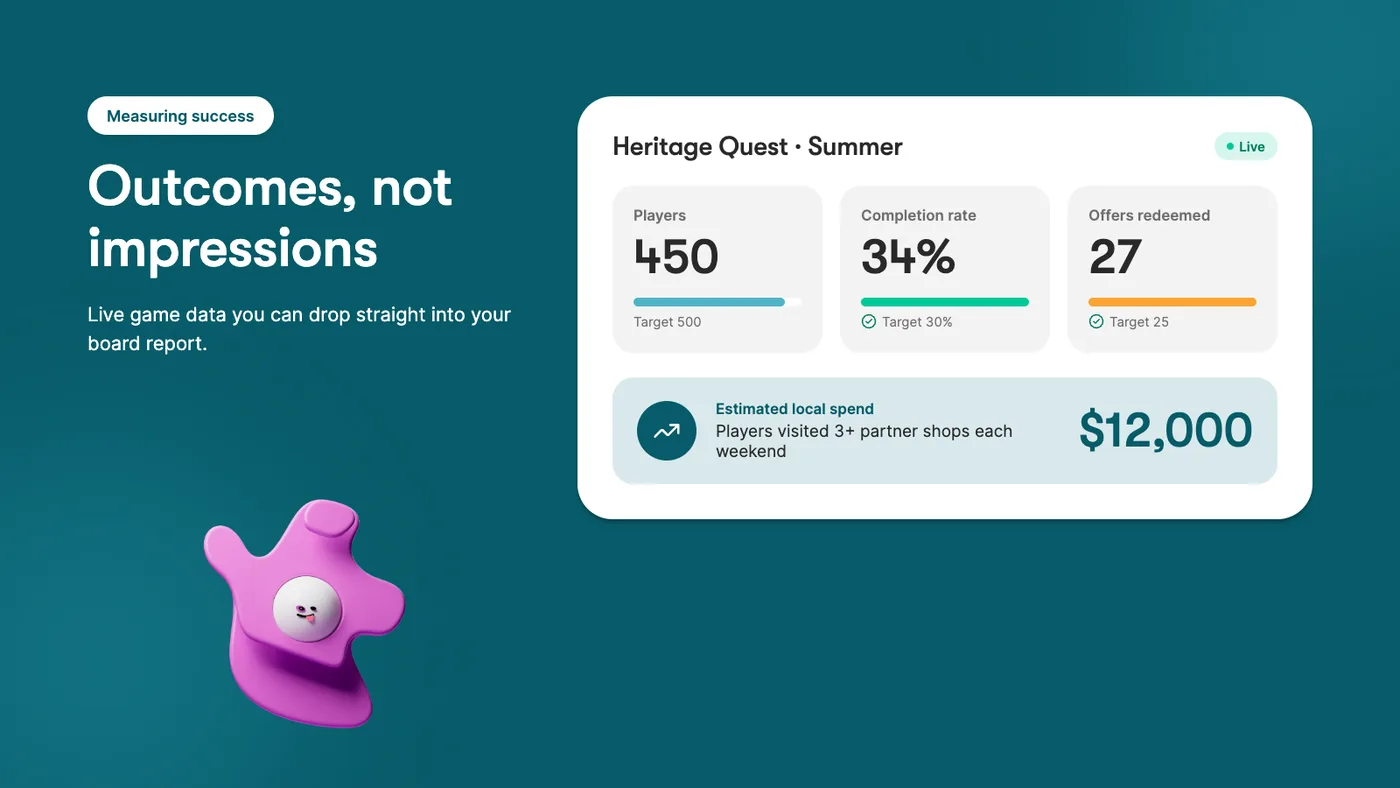
These metrics tie directly to economic impact. For example: "450 players visited at least 3 participating merchants each weekend in summer 2026, generating an estimated $12,000 in incremental local spend." That's the kind of story that keeps your budget funded.
ReadySet's real-time tracking and reporting give DMOs simple dashboards they can screenshot and include in quarterly or annual reports. Set clear targets before launch-500 players in the first month, 30% completion rate, 25 partner offers redeemed per quarter-and adjust routes, content, or incentives based on what the data tells you.
A Step-by-Step Roadmap to Launching a City-Wide Digital Experience
Here's a realistic 8–12 week roadmap that a tourism manager can follow without hiring additional staff.
Weeks 1–2: Discovery and goal-setting
- Define your target audience and theme (families, foodies, history buffs, adventure seekers)
- Set KPIs: player count, completion rate, partner participation, economic impact targets
- Allocate budget and identify potential sponsors
Weeks 3–4: Mapping and partnerships
- Inventory attractions, neighborhoods, and points of interest
- Invite 20–30 local businesses to participate with offers or content
- Involve stakeholders early: city council, chambers of commerce, main street associations
Weeks 5–6: Build the experience
- Use ReadySet's drag-and-drop builder to design map routes, challenges, scoring, offers, and branded visuals
- Write content: stories, trivia, cultural context for each stop
- Connect with the knowledge and expertise of local historians, artists, or residents for authentic material
Week 7: Soft launch
- Open to local residents and tourism staff for testing
- Collect feedback, fix issues, adjust difficulty and content flow
- Confirm all QR codes, signage, and partner offers are working
Week 8: Official launch
- Begin full promotion: social media, email, local media, hotel partnerships
- Activate influencer or ambassador strategy
- Place signage with QR codes at visitor centers and high-traffic locations
Weeks 9–12 and ongoing: Optimize
- Monitor dashboards, track KPIs, rotate seasonal themes
- Refresh content, update offers, add new trails
- Report outcomes to stakeholders and plan next phases
ReadySet's drag-and-drop platform and templates can significantly shorten this timeline for DMOs with limited resources and infrastructure.
Common Destination Marketing Mistakes (and How Always-On Experiences Help)
Every tourism manager has made at least one of these mistakes. The good news: most of them have the same solution.
Mistake 1: Focusing only on peak season. Many destinations shut down or reduce marketing efforts the rest of the year, losing brand presence when travelers are planning future trips. An always-on experience ensures year-round engagement.
Mistake 2: Relying on static brochures and websites. These go stale quickly. Gamified digital layers can be refreshed with new content far more easily-and they're more engaging for consumers who explore on mobile.
Mistake 3: Running many scattered, disjointed projects. Diluted brand, impossible to measure, wasted effort. An always-on experience acts as a central pillar. All campaigns-seasonal, email, social-can point toward it.
Mistake 4: Failing to capture visitor data. Without registration or opt-in, DMOs have little insight into behavior. Interactive experiences auto-collect data with every play.
Mistake 5: Ignoring residents. Locals are powerful destination advocates. Digital city quests designed for residents help them re-explore their own city, creating word-of-mouth that money can't buy.
Modern destination marketing combines storytelling, data, technology, and partnerships. Platforms like ReadySet are built for exactly this combination-helping overworked teams connect all the pieces into one cohesive strategy.
How ReadySet Supports Destination Marketers and DMOs
ReadySet is built for tourism managers and destination marketing organizations who need to create interactive, location-based games and quests without custom development or dedicated engineering resources.
Key capabilities for DMOs:
- Fully branded experiences: your city or county's logo, colors, and identity-not a generic app
- Drag-and-drop event builder: design routes, challenges, offers, and content without writing code
- Mobile multiplayer gameplay: solo or team play with photos, trivia, QR codes, and unlockable stories
- Real-time live tracking: monitor registrations, completions, dwell time, and offer redemptions in a dashboard
- Easy content updates: swap seasonal overlays, rotate partner offers, and add new trails without developer cycles
Always-on use cases include year-round city explorer games, seasonal overlays (holiday lights quest, summer festival trail), educational trails for schools and universities, and corporate team-building for conferences hosted in your city.
Cities and counties can use ReadySet to connect local businesses, attractions, and points of interest into a single cohesive experience-driving measurable foot traffic, engagement, and success across the entire world of destination marketing.
Ready to turn your destination into an interactive playground? Start creating your game for free-design a pilot city quest and launch it within weeks, not months. One game, up to 25 participants, zero cost to start. Your city's next great visitor experience is waiting to be built.
Build an activation like this
Your venue. Your brand.
Our engine.
ReadySet powers branded interactive experiences for agencies, brand teams, and enterprise event programs, without the standalone app build.